 +1 (561) 644-3311
  info@floodresponseassistance.com

An Essential Guide on Flood Insurance Requirements for Commercial Properties
If you own or lease commercial property, flood insurance requirements probably entered your life through a lender. A loan closing, a refinance, a letter announcing your building had been remapped into a flood zone, and suddenly you’re required to carry a policy you may not fully understand.
This guide breaks down when flood insurance is required, what a commercial flood policy actually covers, and the coverage gaps that catch business owners off guard. Because here’s the uncomfortable truth: flood insurance pays you back after the water gets in. It does nothing to keep the water out.
(A note before we begin: this is general information, not insurance or legal advice. Requirements vary by lender, location, and policy. Always confirm specifics with your insurance professional.)
When Is Flood Insurance Required?
The federal mandatory purchase requirement means that flood insurance becomes legally required when three conditions line up:
- Your building sits in a Special Flood Hazard Area (SFHA) – the high-risk zones (typically zones beginning with A or V) on FEMA’s flood maps
- Your community participates in the National Flood Insurance Program (NFIP) – over 22,000 communities do
- Your mortgage is federally backed or comes from a federally regulated lender – which covers the vast majority of commercial real estate lending
When all three apply, federal law requires your lender to make you carry flood insurance for the life of the loan. This is known as the mandatory purchase requirement.
How much coverage is required?
Lenders generally must require coverage equal to the lesser of:
- The outstanding principal balance of the loan, or
- The maximum coverage available under the NFIP for your property type, or
- The insurable value of the structure
- For non-residential (commercial) buildings, the NFIP maximum is $500,000 for the building and a separate $500,000 for contents
Note that if your lender took a security interest in your building’s contents, including equipment, inventory, fixtures, contents coverage is required too, not just the structure. Lenders can also require more coverage than the federal minimum, and many do.
What if you’re outside a high-risk zone?
No federal requirement applies, but that’s a statement about your mortgage, not your risk. Roughly a quarter of NFIP flood claims historically come from properties outside high-risk zones. Moderate- and low-risk properties often qualify for lower-cost policies, and lenders may still require coverage at their discretion.
What Commercial Flood Insurance Actually Covers
A standard NFIP commercial policy has two separate coverages, each with its own deductible:
- Building coverage (up to $500,000) includes the structure and foundation; electrical, plumbing, and HVAC systems; water heaters and pumps; and permanently installed fixtures like carpeting, paneling, and cabinets.
- Contents coverage (up to $500,000) includes furniture, machinery, equipment, and inventory, including raw materials and stock held for sale.
Commercial claims are typically settled at actual cash value – replacement cost minus depreciation – not full replacement cost. If your building suffers substantial damage, NFIP policies also include up to $30,000 in Increased Cost of Compliance coverage to help bring the structure up to current floodplain requirements, such as elevating or floodproofing.
The Gaps: What Flood Insurance Doesn’t Do
This is the section every commercial property owner should read twice.
1. No business interruption coverage – The NFIP does not cover lost income, lost customers, or the cost of operating from a temporary location. Your building can be insured to the full $500,000, and your business can still bleed revenue for every day you’re closed. Separate business interruption or excess private coverage may fill some of this gap, but the cheapest downtime is the downtime that never happens.
2. Coverage limits may not match your exposure – For many commercial properties, $500,000 doesn’t come close to the real value of the building, let alone the equipment and inventory inside it. Excess coverage from private insurers can extend limits, at additional cost.
3. Depreciation eats into payouts – Actual cash value settlements mean your five-year-old HVAC system is reimbursed at its depreciated value, not what it costs to install a new one.
4. The 30-day waiting period – NFIP policies generally take effect 30 days after purchase. You cannot buy coverage when a storm is already on the map. (Sound familiar? The same logic applies to flood barriers – protection acquired during an emergency arrives too late.)
5. Exclusions – Sewer backup not caused by flooding, property outside the building, vehicles, and currency or valuable papers are all excluded.
6. The program itself requires periodic reauthorization – The NFIP operates under authorization from Congress that must be periodically renewed – its current authorization runs through September 30, 2026. During any lapse, new policies and renewals pause until the program is reauthorized. It’s one more reason not to build your entire flood strategy on an insurance policy alone.
Insurance Pays for Damage. Protection Prevents It.
Here’s the reframe worth internalizing: flood insurance requirements exist because lenders want to be made whole after a loss. Your goal is different – you want the loss not to happen.
That’s where physical flood protection complements a required policy:
- A site-specific flood risk assessment identifies exactly how water would enter your building and what it would cost you, informing both your protection plan and smarter coverage decisions.
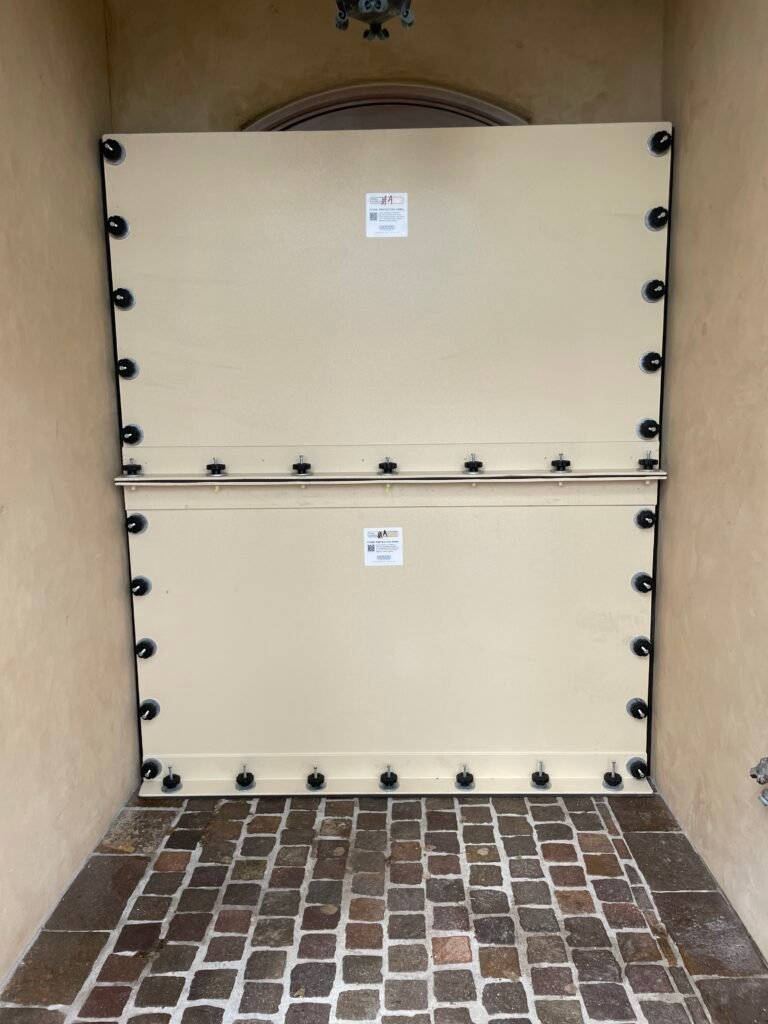
- Deployable flood barriers with a deployment plan keep water out of the building entirely, protecting everything insurance undervalues: depreciated equipment, irreplaceable records, and every day of revenue a closure would cost.
- Flood vents for enclosed areas below elevated buildings allow floodwater to flow through rather than build up pressure against walls. Properly installed, engineered flood vents help satisfy floodplain construction requirements and can favorably affect how your flood risk is rated.
- Mock deployment training ensures that when a warning is issued, your protection actually gets deployed.
The strongest position for a commercial property owner is both: the coverage your lender requires, and the physical protection that means you may never need to use it.
Take the Next Step
Flood insurance requirements tell you the minimum you must carry, but they don’t tell you how to keep your business dry. Flood Response Assistance provides site-specific flood risk assessments, flood vent installation, 24/7 emergency flood barrier deployment, and mock deployment training for commercial properties nationwide.
Contact Flood Response Assistance today to find out how to protect your property while meeting flood insurance requirements for your peace of mind.